
A retaining wall is only as stable as what is under it and what is packed behind it. Leatherneck Landscaping builds about 8 inches of compacted 3/4-inch limestone and sand under block walls: a trench is excavated, the limestone and sand are placed and leveled, and the first course of River Red concrete retaining wall blocks is set so it is buried, not perched on the lawn. Free-draining aggregate is packed behind the wall, and the excavated dirt is hauled off. That work is what keeps a wall from leaning or kicking out on North Texas clay.
Why do retaining walls fail at the base, not at the face?
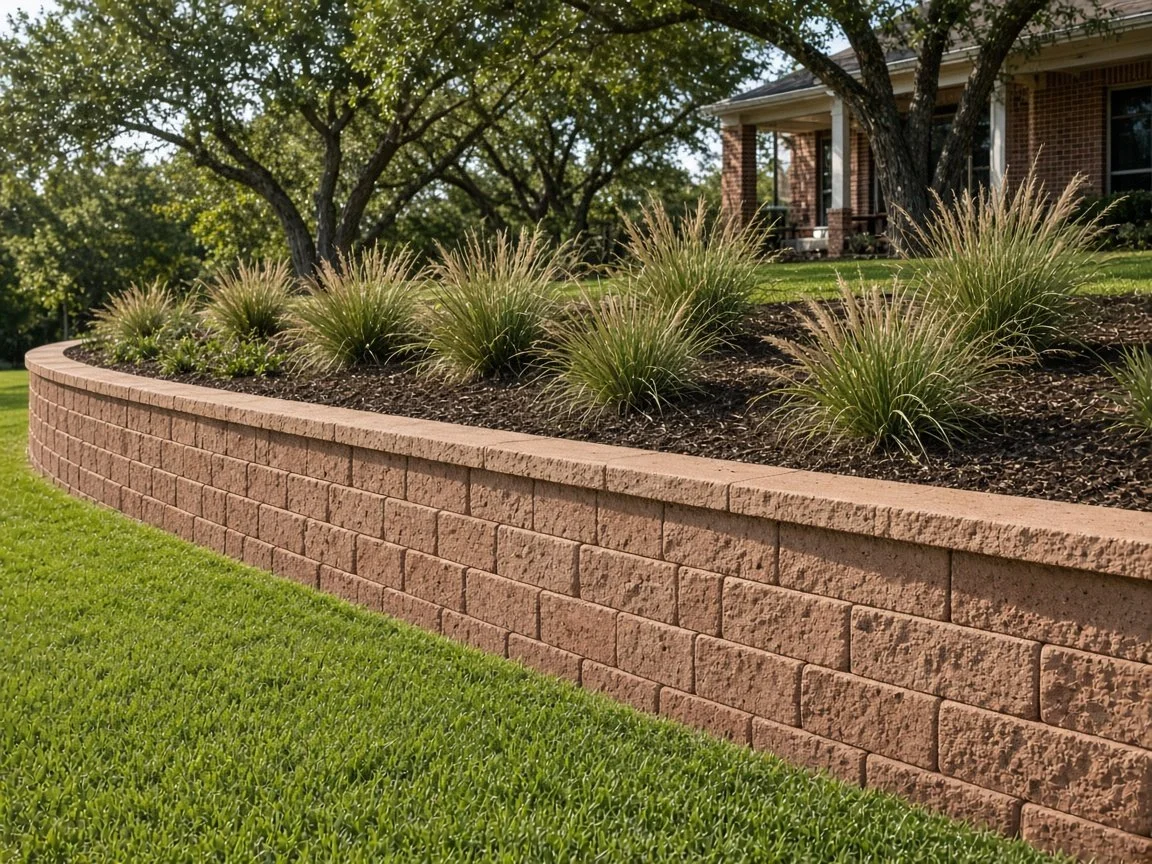
Example retaining wall (example photo, not a Leatherneck job)
Most walls that lean or bulge failed because the first course was set on loose soil, the trench was too shallow, the base was not compacted and level, or the soil behind the wall had no path for water to escape. A River Red block wall is a dry-stacked system, so each course depends on the one below it. If the first course is out of level, every course above it follows that error. If water sits in clay behind the wall, the soil swells and pushes, and the face begins to lean.
What does 8 inches of ground work include on a block wall?
Leatherneck's standard is about 8 inches of compacted 3/4-inch limestone and sand under the wall.
A trench, and dirt haul-off. The crew excavates a trench deep enough for the compacted limestone and sand and the buried first course, and hauls off the soil instead of packing it back against the wall as the only backfill. Before any digging, underground utilities should be marked by calling 811.
A compacted 3/4-inch limestone base. 3/4-inch limestone is placed and compacted into a firm, level pad. Industry guides for segmental retaining walls commonly call for a compacted granular leveling pad on the order of 6 inches thick. Leatherneck's practice is about 8 inches of compacted 3/4-inch limestone and leveling sand under the first course.
Leveling and burying the first course. The first course decides the wall. Each block should sit in full contact with the base, be checked for level, and be set in the trench so finished grade buries it. Industry guidance treats this embedment as a basic stability step, with a common practical minimum of 6 inches, or one block unit, below finished grade.
Drainage aggregate and backfill. Clean, free-draining stone is packed in any block cores and behind the wall so water has a path out of the clay. Industry guides typically call for at least 12 inches of this drainage aggregate behind the units, with soil backfill compacted in 6- to 8-inch lifts. River Red concrete retaining wall blocks are the units Leatherneck uses for this work, and they still need that prepared base.
Why does North Texas clay make this ground work non-negotiable?
The same shrink-swell clay that troubles patios and foundations is hard on walls. Texas A&M AgriLife Extension describes the cycle: dry clay shrinks; when moisture returns, the clay expands and can lift what sits on it. AgriLife's Travis County office notes that Blackland Prairie clays form wide cracks and can heave objects such as fence posts and patios. Houston Black, the classic Texas Blackland clay found from north of Dallas south toward San Antonio, has a very high shrink-swell potential.
A wall with no compacted base and no drainage is sitting in that movement and can lean, kick out, or drop after a few wet-dry cycles. Those problems are prevented in the trench, with a compacted 3/4-inch limestone base, a buried first course, and free-draining stone behind the blocks, in Johnson, Ellis, and Tarrant counties. Taller walls, walls that hold a slope or a driveway, and poorly drained sites can need more than a basic gravity wall. Leatherneck looks at the site and will tell you what the job requires.
Do you build retaining walls in Mansfield, Waxahachie, and nearby?
Yes. Leatherneck Landscaping is a Marine veteran-owned company based in Venus, Texas. River Red block walls and other hardscaping are available for homes and businesses in Mansfield, Burleson, Arlington, Kennedale, Midlothian, Waxahachie, Alvarado, and Venus, plus nearby communities in Johnson, Tarrant, and Ellis counties. Call or text 817-875-1409 to confirm your address.
See the Landscaping page and the Hardscaping page for related outdoor work. The same ground-work idea applies under a patio; see Why Paver Patios Need 8 Inches of Ground Work. To get a quote, call or text 817-875-1409, or fill out the free quote form.
Frequently asked questions
Why do you bury the first course of a retaining wall? The first course is buried so the wall has a solid toe in the ground, not a row of blocks sitting on the lawn. That embedment helps the wall resist sliding and protects the base.
Can you just stack River Red blocks on the soil? No. River Red blocks still need a trench, about 8 inches of compacted 3/4-inch limestone and sand, a level first course, and drainage behind the wall. Stacking on bare soil is how walls lean, settle, and kick out on North Texas clay.
What is the stone behind the wall for? The free-draining aggregate behind the wall, and in the block cores, gives water a path out so it does not build up in the clay and push on the face. It is a drainage layer, not leftover dirt packed back into the trench.
Do you build retaining walls in Midlothian, Waxahachie, and Alvarado? Yes. Leatherneck builds River Red block walls throughout its service area, including Midlothian, Waxahachie, Alvarado, Mansfield, Burleson, Arlington, Kennedale, and Venus. Call or text 817-875-1409 to confirm your address.
Ready for a wall that starts in the ground?
If you need a retaining wall that will stay straight on North Texas clay, Leatherneck can handle the trench, the compacted limestone base, the River Red blocks, and the drainage behind them. Call or text 817-875-1409, or request a free quote today.